How to set boundaries with parents: helpful tips from a therapist
If you’ve ever felt guilty before and after you set a boundary, you’re not alone.
In this article, we’ll cover why you may have trouble setting boundaries and why boundaries are helpful. I’ll also provide some scripts and affirmations to help you get started.
As a licensed therapist who works with Latinas with immigrant parents in New York, I help my clients set boundaries with their parents in way that improves the relationship. It can be scary, but it can be done.
Setting boundaries can disrupt expectations
For many bicultural Latinas, boundaries don’t just feel uncomfortable — they feel disloyal.
Many Latino families emphasize closeness and sacrifice. Filial duty, deference and service to our elders are core values that are often expected, especially of first-born daughters.
Feeling guilty doesn’t mean you did something wrong
When you first begin to assert your needs, you’re also challenging your family’s expectations. Your nervous system may interpret that as a risk — that’s why it feels so hard. Doing something new is often scary.
If you’re nervous about setting boundaries, you might notice:
Over-explaining your decisions
Saying “yes” to avoid tension
Feeling selfish
Bracing for a backlash
This tension is real, and it deserves nuance.
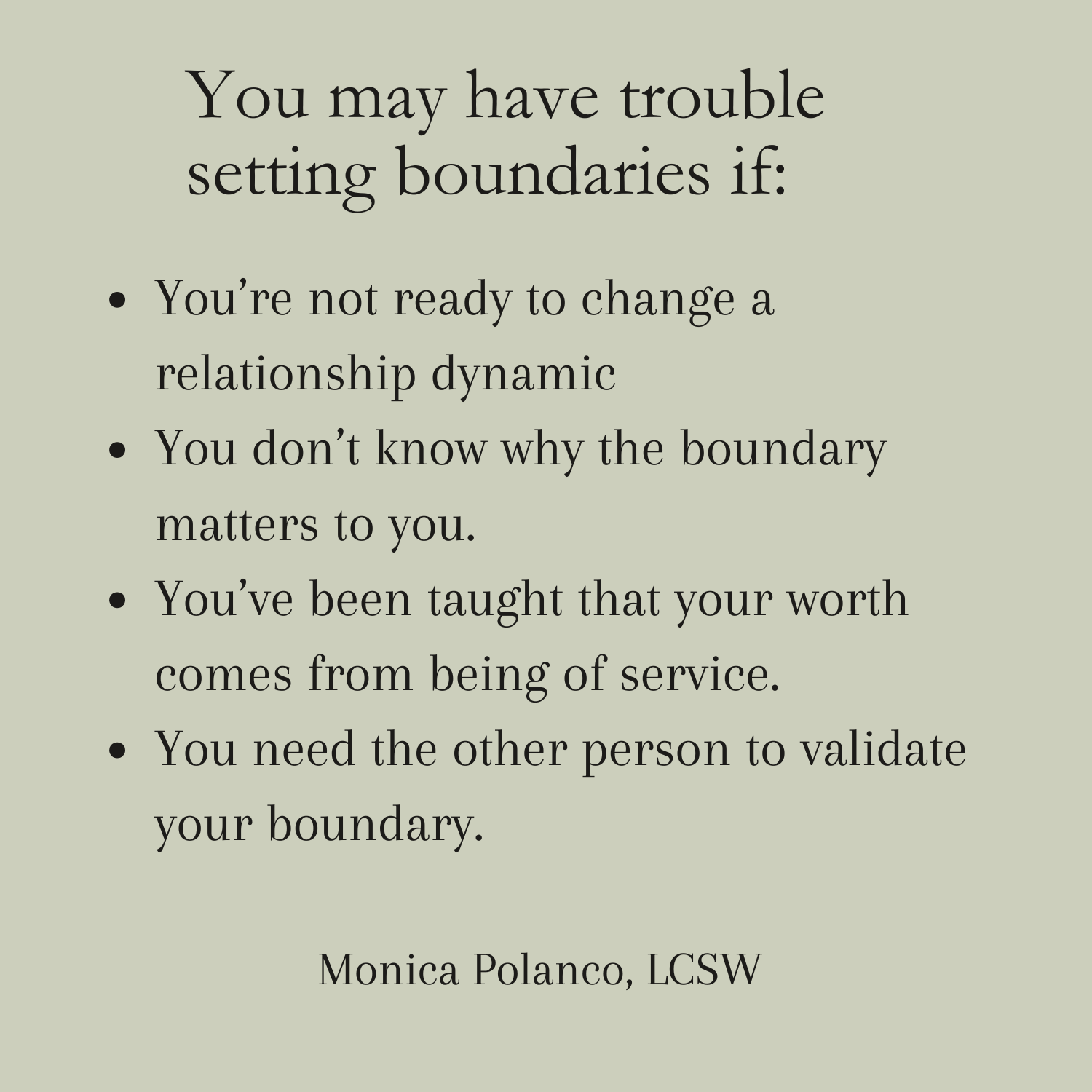
You may have trouble setting boundaries if you’re been taught to always be available.
Get curious about why you’re having trouble setting boundaries
Interconnectedness, collaboration and mutual support within families can be a source of love, pride and strength.
But there’s a difference between wanting to connect with loved ones and wanting to avoid criticism or conflict. Giving from love is not the same as giving out of fear or obligation. Fear-based compliance sacrifices our needs, desires and basic functioning.
You may have trouble setting boundaries if:
You’re not ready to possibly change a relationship dynamic.
You’re not clear on why the boundary matters to you.
You’ve been taught that your worth comes from being of service.
You need the other person to validate your boundary before you can enforce it.
Working on boundaries involves exploring the thoughts that make setting boundaries difficult.
Do you have an “all or nothing” mindset that eliminates the possibility of a healthy middle?
Do you assume that you’ll always receive the same reaction or that one person’s feelings represent the entire family’s?
Do you imagine the worst and give up?
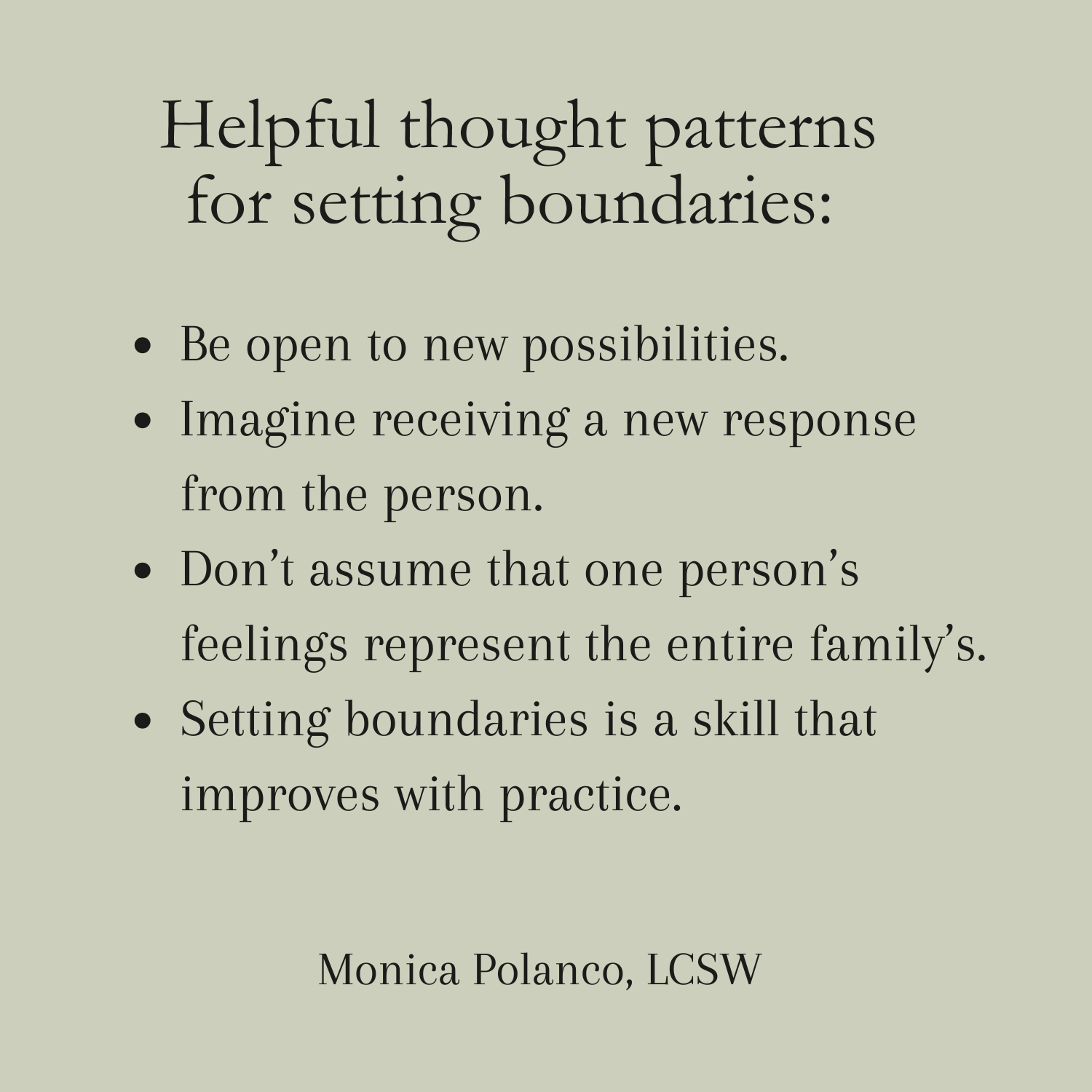
Before setting a boundary, have an open mind about your desired outcome.
Consider changing the way you think about boundaries
A reframe might help.
Boundaries aren’t about hurting the other person. They protect your energy and acknowledge what you can and cannot handle. They allow you to show up without resentment when you do say “yes.”
Boundaries play a role in healthy relationships
Boundaries strengthen our sense of self and create more honesty within our relationships. They allow us to show up authentically, rather than with resentment.
If you’re looking for guidance, these boundary scripts can help:
When your parents question your choices, you might try saying something like:
“I’ve thought a lot about this, and I feel good about my decision.”
When you need space, emotionally or physically, try saying:
“I’m exhausted. I need some time on my own to recover.”
Take it one step at a time
Be patient and give yourself some grace. Creating boundaries is a skill — one that you learn over time. Give yourself freedom to experiment and see what feels right for you. Boundaries are not always set in stone — one day, you might want to say “no;” another day, you might want to say “yes.”
As you improve your boundary-setting skills, consider encouraging yourself with the following affirmations:
My worth is not tied to not having boundaries.
Boundaries allow me to show up more fully and genuinely.
Boundaries are not barriers to keep people out — they’re invitations to be loved in the ways I need.

Affirmations can help you start setting boundaries.
How to set boundaries with your parents: Conclusion
Setting boundaries with your parents can be challenging, especially if you’ve never done it before. With time and practice, you can become more confident expressing your needs and setting limits so that you can protect your energy.
Setting boundaries doesn’t require perfection. It requires tuning into your needs and being honest about what you can and can’t do. That way, when you do show up, your presence is genuine, not resentful.
If you’re looking for a licensed therapist in New York who understands the unique challenges of being a first-generation Latina, I can help. I also support women who are seeking a Spanish-speaking therapist in New York.
To learn more, visit my page on therapy for guilt and boundaries.
I invite you to book a free consultation here. I’d love to see if we’re a good fit.
Source
Kohli, S.K. (2024). But what will people say? Navigating mental health, identity, love and family between cultures. Penguin Random House.