People-Pleasing Anxiety — Therapist-backed Tips for Healing
Are you curious about how people-pleasing behaviors can lead to anxiety?
This article will define people-pleasing, provide information about anxiety and offer suggestions for healing.
As a licensed therapist who works with first-generation Latinas in New York, I help my clients understand how cultural factors can influence their mental health, including anxiety, burnout and guilt around setting boundaries.
What is people-pleasing and what causes it?
People-pleasing occurs when someone focuses on the needs of others at their own expense.
People-pleasing is not simply being generous. It’s a series of behaviors designed to get people to like you and avoid rejection or criticism.
The people-pleaser becomes a blank canvas and other people become the colors designed to bring that canvas to life. This places the people-pleaser’s agency and self-worth in the wrong hands — other people.
Chronic people-pleasing is associated with anxiety, depression, burnout and neuroticism — the tendency to be easily overwhelmed.
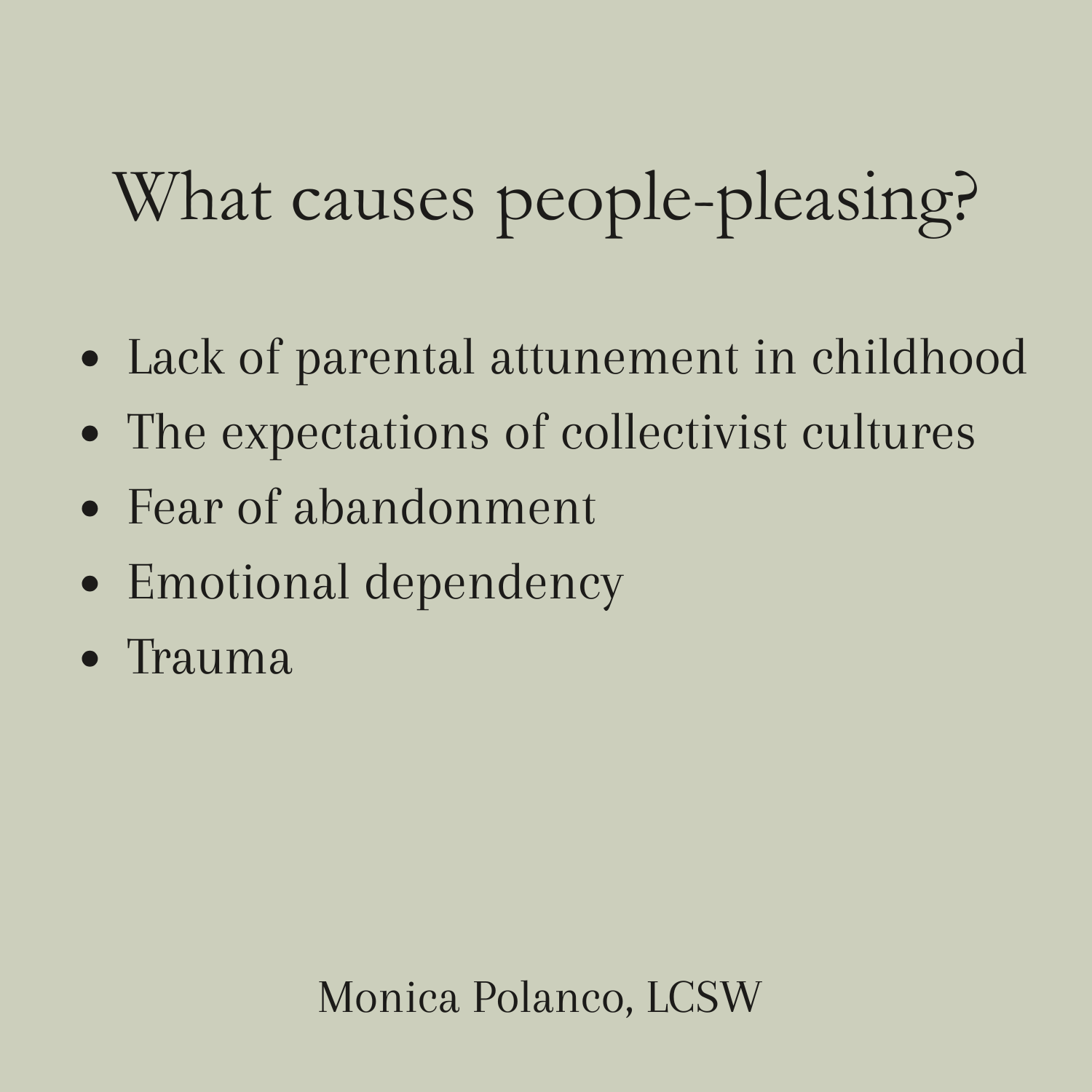
People-pleasing can be caused by fear of abandonment or other attachment issues.
People-pleasing may arise in early childhood. For example, some children grow up having to earn their parents’ love and affection. Others may have an emotionally unavailable parent or receive inconsistent parental care.
In these cases, the child learns to disregard their needs and attune their behavior to the other person. This is a survival strategy that can continue into adulthood.
People-pleasing can also develop among collectivist cultures that value social harmony. In this case, the individual learns to place the needs of the group above their own.
In people-pleasing, there may be a fear of abandonment, poorly-defined boundaries, emotional dependency or trauma.
In emotional dependency, the person tries to satisfy their unmet need for closeness through their relationships. They may have a deep longing for connection, and abandon their needs to fill that void.
Fawning is a trauma response in which people-pleasing is used to avoid conflict and preserve the relationship at all costs.
People-pleasers tend to be highly agreeable. In accommodating others, they lose the opportunity to express who they are and be known in a meaningful way. They're left with shallow, unsatisfying connections, psychological distress and loneliness.
People-pleasers tend to have low self-esteem and emotional instability because they rely on other people for their self-worth.
They may develop anxiety because of the excessive pressure they place on themselves to please others.
How common is anxiety?
Anxiety disorders — the most common mental illness among Americans — affects 40 million adults over the age of 18 every year, according to the Anxiety & Depression Association of America.
Anxiety is an umbrella term that includes such disorders as generalized anxiety disorder (GAD), panic disorder, agoraphobia and social anxiety disorder.
Anxiety disorders are serious medical conditions — just like high cholesterol — and they affect overall wellness. For example, people who have an anxiety disorder are 3-5 times more likely to see a doctor, according to the Anxiety & Depression Association of America.
Anxiety can develop from a complex interplay that includes genetics, brain chemistry, personality and experiences. Women are almost twice as likely as men to be diagnosed with anxiety, according to the Anxiety & Depression Association of America.
Anxiety is very treatable, but only 1 in 4 people receive treatment.
Anxiety symptoms
Having occasional anxiety can be a normal reaction to life’s demands, such as a presentation at work or a test at school. Occasional anxiety resolves once the challenge is completed.
Anxiety disorders are much different. People with an anxiety disorder have intense, persistent worry and fear about ordinary situations. These fears interfere with daily activities, are difficult to manage and disproportionate to the situation.
Anxiety symptoms include:
Feeling nervous, irritable or on edge
Having a rapid heart rate
Difficulty concentrating
Trouble sleeping
Gastrointestinal problems (including bloating, diarrhea, nausea or heartburn)
People-pleasing examples
People-pleasing is a counter-productive attempt to gain love and self-worth and ward off abandonment or rejection.
People-pleasers struggle to express their own needs and may become resentful or feel depleted when they don’t receive the support or approval they desire.
Depending on other people for approval can create emotional imbalances due to over-giving and harm the people-pleaser’s sense of self.
Examples of people-pleasing include:
Catering to other people’s needs at one’s own expense
Being overly agreeable
Silencing one’s needs
Having weak boundaries
Avoiding disagreements
Maintaining closeness through self-sacrifice
People-pleasing therapy
Healing from people-pleasing is possible. Working with a licensed therapist can help.
In therapy, people with people-pleasing tendencies can learn to form healthy relationships, set clear boundaries and advocate for their needs. They learn that they can take care of themselves and maintain healthy relationships.
The therapeutic relationship can provide a what’s known as a corrective emotional experience. To do this, the therapist creates a compassionate, supportive environment that helps clients re-frame painful experiences, learn new ways of relating with other people, become more resilient and experience personal growth.
Tips for reducing people-pleasing tendencies
Change often starts with self-awareness. This means identifying patterns with curiosity and compassion so that we can learn from them and make more conscious, healthy choices.
Taking stock of the cost of people-pleasing can also help. This can include examining your relationships — are they reciprocal, or are you burning yourself out by doing too much? What do you lose by giving more than you can afford to? How would your life be different if you had more energy for yourself?
The following tips can help:
Identify your needs first
Ask yourself: Why do you want to help — do you have a hidden motive?
Set clear limits with the people in your life
Speak up when something bothers you
Find activities that bring you joy and healthy connections
Only say “yes” when you actually want to participate
People-pleasing anxiety and how to heal: Conclusion
People-pleasing is a counter-productive attempt to avoid rejection or gain approval. People-pleasing can lead to anxiety, depression and shallow, unsatisfying relationships.
Healing from people-pleasing starts with becoming curious about what this behavior is seeking to accomplish and evaluating it’s effectiveness.
Often, people-pleasers place so much pressure on themselves to accommodate others, that they lose their connection to themselves.
Healing involves restoring the people-pleaser’s importance in their own life and learning to create authentic, reciprocal relationships.
If you’re looking for a licensed therapist in New York who understands the unique challenges of being a first-generation Latina, I can help. I also support women who are seeking a Spanish-speaking therapist in New York.
I invite you to book a free consultation here. I’d love to see if we’re a good fit.
Sources:
Anxiety & Depression Association of America. Anxiety Disorders - facts & statistics.
Chicago Psychoanalytic Institute. (April 22, 2025). Corrective emotional experience: A pathway to emotional healing.
Kuang, X., Li, H., Luo, W., Zhu, J., & Ren, F. (2025). The Mental Health Implications of People-Pleasing: Psychometric Properties and Latent Profiles of the Chinese People-Pleasing Questionnaire. PsyCh journal, 14(4), 500–512.
Mayo Clinic. (July 29, 2025). Anxiety Disorders.
Moore, M. (March 27, 2024). The psychology of people-pleasers. Psych Central.
Psychology Today. (March 16, 2018). How I learned to stop being a people-pleaser.
Strauss Cohen, I. (May 19, 2026). People Pleasing. Psychology Today.
Widiger, T. A., & Oltmanns, J. R. (2017). Neuroticism is a fundamental domain of personality with enormous public health implications.World psychiatry : official journal of the World Psychiatric Association (WPA), 16(2), 144–145.